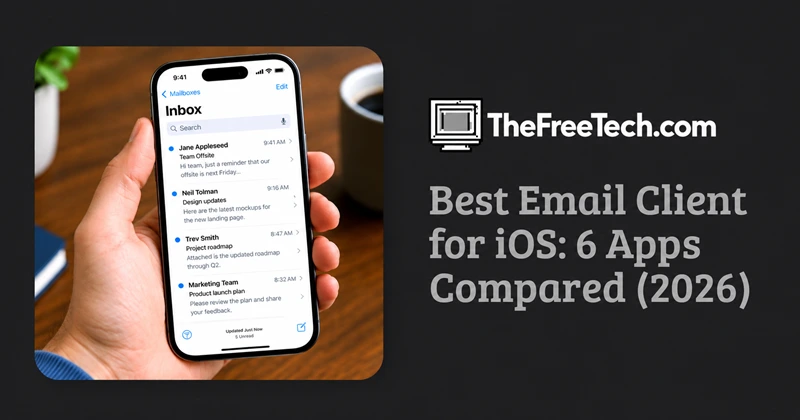
Best Email Client for iOS: 6 Apps Compared (2026)

The best email client for iOS for most people is Apple Mail. It is free, comes with the iPhone, and supports multiple email providers. However, Gmail is a better fit for Google users, Outlook works well for Microsoft 365, and Proton Mail is worth considering if encrypted email is your priority.
The right choice depends on how you manage email, which services you already use, and whether you need advanced productivity features.
The 6 Best Email Clients for iOS
| Email client | Best for | Main advantage |
|---|---|---|
| Apple Mail | Everyday email | Free and built in |
| Gmail | Google users | Gmail and Google Workspace integration |
| Microsoft Outlook | Work email | Microsoft 365 and calendar integration |
| Spark Mail | Inbox productivity | Smart inbox organization |
| Proton Mail | Privacy-focused users | End-to-end encryption for supported communications |
| Airmail | Advanced users | Customization and workflow integrations |
1. Apple Mail — Best overall for everyday use
Apple Mail is the best starting point for iPhone users who want a straightforward email experience without another subscription.
It supports iCloud Mail, Gmail, Outlook, Exchange, Yahoo, and compatible IMAP accounts. You can manage multiple addresses, search messages, organize conversations, and use Apple's built-in privacy features.
Best features
Free with no separate email-client subscription.
Integration with the Apple ecosystem.
Support for multiple email providers.
Mail Privacy Protection to help limit sender tracking.
Native iPhone and iPad experience.
Limitation: Users who depend on specialized Gmail features, sophisticated inbox automation, or advanced collaboration tools may prefer a dedicated alternative.
Choose Apple Mail if: You want a reliable, no-cost app for personal and professional email without unnecessary complexity.
2. Gmail — Best for Google users
Gmail is the natural choice for people who rely on Google Workspace, Google Calendar, Google Drive, and other Google services.
Its strength is the connection between your inbox and Google's ecosystem. Gmail also offers powerful search, spam filtering, labels, and inbox organization.
Best features
Strong integration with Google services.
Search and label-based organization.
Spam filtering and category-based inbox management.
Support for multiple accounts.
Limitation: The interface and organization are designed around Google's approach to email. Users who want a more neutral interface across several providers may prefer Apple Mail or Spark.
Choose Gmail if: Your primary email address is Gmail or your workplace uses Google Workspace.
3. Microsoft Outlook — Best for work email
Microsoft Outlook is a strong option for professionals using Microsoft 365 or Exchange. It combines email with calendar and contact management, making it useful for coordinating meetings and managing work communications.
Best features
Microsoft 365 and Exchange integration.
Built-in calendar and scheduling tools.
Focused Inbox for separating prioritized messages.
Integration with other Microsoft services.
Limitation: Some advanced productivity and AI features depend on your Microsoft subscription or account type. The experience can also feel more feature-heavy than a basic mail app.
Choose Outlook if: Your organization relies on Microsoft 365, Teams, Exchange, or Outlook calendars.
4. Spark Mail — Best for inbox productivity
Spark Mail is designed for people who want more structure than a conventional chronological inbox provides. Its productivity-oriented features help users prioritize messages and process email more deliberately.
Best features
Smart inbox organization.
Customizable email workflows.
Snoozing and follow-up tools.
AI-assisted features and collaboration options, depending on the plan.
Limitation: Some capabilities require a paid plan, and users should review how the app handles message data before enabling cloud-based AI or collaboration features.
Choose Spark if: You manage several accounts, receive large volumes of email, or want tools that support a more organized inbox workflow.
5. Proton Mail — Best for privacy-focused email
Proton Mail is built around email privacy and encryption. It is particularly useful for people who want a privacy-focused email service rather than simply a different interface for their existing inbox.
Messages between Proton users can benefit from end-to-end encryption. Communication with recipients on other email services has different protections, so encryption should not be assumed for every message.
Best features
End-to-end encryption for supported communications.
Privacy-focused email service.
Apps for mobile devices and other platforms.
Free and paid account options.
Limitation: Proton Mail is not a universal replacement interface for every existing mailbox. If you need to consolidate Gmail, Outlook, and iCloud accounts, check its account compatibility before switching.
Choose Proton Mail if: Privacy and encrypted communication matter more to you than managing every provider from a single inbox.
6. Airmail — Best for customization
Airmail is worth considering if you want more control over how email actions and integrations work. Its appeal is its customizable approach to managing messages and connecting email with other productivity tools.
Best features
Customizable actions and workflows.
Integration options for productivity tools.
Support for compatible email accounts.
Features aimed at advanced users.
Limitation: Some capabilities require a subscription, and the additional customization may be unnecessary if you only need basic email.
Choose Airmail if: You want to tailor your email workflow instead of using a more standardized interface.
Which Email Client Should You Choose
Use these practical rules to narrow down your options:
You want a free app that just works: Start with Apple Mail.
You use Gmail every day: Choose Gmail for its native Google integration.
Your work runs on Microsoft 365: Choose Outlook.
You want a more organized inbox: Consider Spark Mail.
You prioritize encrypted communication: Consider Proton Mail.
You want customizable workflows: Look at Airmail.
There is no need to switch apps simply because another one has more features. If your current app handles your accounts reliably, gives you the notifications you need, and makes messages easy to find, switching may not improve your experience.
What to Check Before Switching Email Apps
Before installing a new client, check these four things:
1. Account compatibility
Confirm that the app supports your existing email provider. Some apps are general-purpose clients, while others are designed primarily for their own email services.
2. Free-plan limitations
Check how many accounts you can connect, which features require payment, and whether the free plan meets your needs.
3. Privacy and data handling
Look for clear information about message storage, tracking protection, AI processing, and whether email content is sent to external servers.
4. Notifications and daily workflow
Make sure the app supports the notification behavior, search, attachment handling, and organization tools you actually use. For work accounts, confirm that your organization's security policies permit the app.
FAQ
What is the best free email client for iOS?
Apple Mail is the strongest default choice for most users because it is free and supports multiple major email providers. Gmail is another good free option if you primarily use a Google account. Check current plan terms before relying on premium features from third-party apps.
Is Apple Mail better than Gmail on iPhone?
Apple Mail is better suited to users who want one simple client for multiple providers and close integration with iOS. Gmail is preferable for users who rely on Google Workspace, Gmail labels, and Google's integrated services.
Can I use multiple email accounts in one iPhone app?
Yes. Apple Mail, Gmail, Outlook, and Spark support multiple-account workflows, although supported providers and the available features vary. Confirm compatibility if you use a less common email service.
Is Proton Mail more secure than Apple Mail?
They offer different security models. Proton Mail provides end-to-end encryption for supported communications, while Apple Mail offers privacy features such as Mail Privacy Protection. Neither feature means every message sent to any recipient is automatically end-to-end encrypted.
Should I replace the default iPhone Mail app?
Only if another app solves a specific problem. Better integration with your work platform, more advanced inbox organization, or a different privacy model can justify switching. Otherwise, Apple Mail remains a practical starting point.