Free Teleprompter Apps for Mac: 2026 Guide

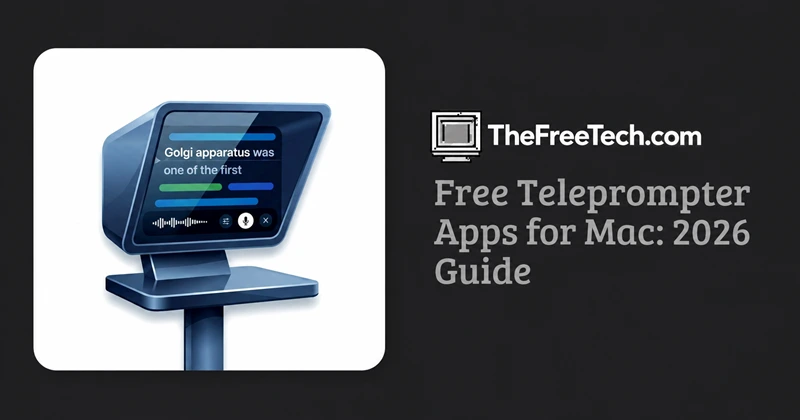
If you need a free teleprompter app for Mac, there are several genuinely free options in 2026, including open-source Mac apps and browser-based tools. The main difference is whether you need voice-following, camera-friendly positioning, screen-sharing invisibility, or simply basic scrolling.
Quick picks
- Textream: free, open-source, with word tracking, voice-activated scrolling, and classic auto-scroll. Requires macOS 15 or later.
- NotchPrompter: free and open-source, with voice activation and a display designed around the Mac's top area. It supports macOS 14+ and external monitors.
- CueCard: completely free and open-source, with Mac and Windows desktop versions. It is particularly useful when you want speaker notes that stay out of your screen share.
- DocPrompter: a browser-based option that requires no Mac installation. It works in Safari or Chrome and can be used alongside QuickTime.
- Reprompt: a Mac app whose basic teleprompter is currently free, with paid Pro features for recording, unlimited scripts, and additional imports.
Free Mac Teleprompters Compared
| Option | Free? | Voice-following | Mac requirement | Best suited to |
|---|---|---|---|---|
| Textream | Yes | Yes | macOS 15+ | Video, streaming, presentations |
| NotchPrompter | Yes | Yes | macOS 14+ | Camera-facing recording and calls |
| CueCard | Yes | Not its main focus | macOS / Windows | Presentations and screen sharing |
| DocPrompter | Yes to start | Yes in supported browser setups | Any modern Mac browser | No-install prompting |
| Reprompt | Yes | Voice Pause | Mac | Traditional teleprompter use |
| Teleprompter | Free tier | - | Mac | More conventional prompting |
Feature availability can change, particularly for apps with paid upgrades, so check the current product listing before choosing one.
Textream: a free open-source option
Textream is designed specifically for people who need to read a script while speaking. Its Mac version supports three prompting modes:
- Word tracking, which highlights words as you speak
- Classic auto-scroll
- Voice-activated scrolling, which advances while you speak and pauses when you stop
It can display the script as a Dynamic Island-style overlay, a floating window, or fullscreen on a Sidecar iPad. Textream is free and open-source and does not require an account. Its current Mac version requires macOS 15 or later.
Best for: creators, podcasters, presenters, and anyone who wants the script to react to their speech.
NotchPrompter: useful for camera-facing videos
NotchPrompter takes a different approach: it places the script near the top of the display, including the MacBook's notch area, to keep the text close to the camera.
Its site says the app is free and open-source, supports voice-activated scrolling, works with external monitors, and can operate on Macs without a notch. It currently requires macOS Sonoma 14 or newer.
One particularly useful feature is its claimed screen-recording and screen-sharing behavior: the developer says the prompter does not appear in recordings or screen shares such as Zoom and Google Meet.
Best for: Zoom calls, presentations, and videos where maintaining eye contact with the camera matters.
CueCard: best when presentation notes matter
CueCard is a free, open-source teleprompter available for macOS and Windows. Its desktop version is designed around speaker notes rather than simply putting a large scrolling script over your screen.
It can also use cues such as reminders to pause or change delivery, while presentation notes can remain separate from what your audience sees.
Best for: presentations, lectures, meetings, and speakers who want notes without putting those notes into the audience's screen share.
DocPrompter: no installation required
If you don't want another Mac application, a browser-based teleprompter may be easier.
DocPrompter runs in Safari or Chrome, so there is no App Store installation or desktop installer to maintain. Its documentation says it supports manual and fixed-time scrolling, while voice-following is available in Chrome on desktop. It can also be positioned alongside QuickTime when recording.
Best for: occasional use, work Macs where you cannot install software, or anyone who wants to start prompting immediately.
Reprompt: free Mac app with optional Pro features
Reprompt is another Mac-native option. Its current App Store listing says the core teleprompter is free and includes features such as words-per-minute speed control, text mirroring, Voice Pause, multiple fonts and themes, folders, search, and iCloud synchronization.
The free version allows up to three scripts. Pro adds features including recording, unlimited scripts, and importing PDF, Word, and plain-text files.
Best for: users who want a straightforward native Mac teleprompter and may eventually want integrated recording.
What Does “free teleprompter” Actually Mean
Before installing an app, check which of these models you're getting:
Completely free:
The core application is available without a subscription or paid unlock. Textream and CueCard describe themselves as free/open-source projects.
Free with optional paid features:
The basic teleprompter works for free, but recording, unlimited scripts, imports, or advanced controls may require payment. Reprompt is an example.
Free download with paid access:
Some Mac App Store teleprompters are free to download but put additional functionality behind in-app purchases or subscriptions. The App Store listing for Teleprompter: Floating Notes, for example, describes subscription-based unlimited access.
So if your requirement is “I don't want to pay anything,” don't judge an app simply by whether the App Store button says Free.
Choose Based on What You're Doing
Recording YouTube videos
Look for voice-following or adaptive scrolling and text positioned close to the camera. This reduces the visual difference between looking at your script and looking at the viewer.
Textream and NotchPrompter both provide voice-related prompting features.
Zoom, Teams, or Google Meet
Screen-sharing behavior becomes more important than recording features. A teleprompter that remains visible only to you can let you read notes without putting them into the shared presentation.
NotchPrompter specifically states that its overlay is invisible to screen recording and screen sharing. CueCard is also designed around keeping speaker notes separate from the shared screen.
Presentations
You may not need a traditional scrolling teleprompter at all. A speaker-note tool such as CueCard can be more appropriate when your presentation slides need to remain visible to the audience.
Occasional use
A browser-based tool such as DocPrompter can be simpler than installing an application you only use occasionally.
Older Mac
Check the macOS requirement before installing. Textream currently requires macOS 15+, while NotchPrompter requires macOS 14+.
What Matters Most in a Mac Teleprompter
1. Where the text appears
Text near the webcam generally makes it easier to maintain eye contact than text positioned far down the display.
2. How scrolling works
Fixed-speed scrolling is predictable, while voice-following can adapt when you pause or change your speaking speed.
3. Whether it appears in screen recordings
This is critical if you're recording your screen or presenting through Zoom, Meet, or similar software.
4. Script limits
A free app may still restrict the number of scripts, document imports, or other features.
5. Your macOS version
Newer apps may require recent versions of macOS.
FAQ
Is there a completely free teleprompter for Mac?
Yes. Textream and CueCard describe their Mac software as free and open-source, while NotchPrompter also states that it is 100% free and open-source.
Can I use a teleprompter on a Mac without installing an app?
Yes. Browser-based options such as DocPrompter run directly in Safari or Chrome, so there is no desktop installation.
Can a Mac teleprompter follow my voice?
Yes. Textream supports word tracking and voice-activated scrolling, while NotchPrompter supports voice-activated scrolling.
Can I use a teleprompter during Zoom?
Yes, but choose one carefully. The important question is whether the prompting overlay is included in your screen share. NotchPrompter specifically says its overlay remains invisible to screen sharing, while CueCard is designed to keep speaker notes out of the shared screen.
Do I need a MacBook with a notch?
No. Notch-focused apps can still support Macs without a notch. NotchPrompter, for example, says it works on any Mac and can also use floating or other screen positions.
What is the easiest free option if I don't want to install anything?
A browser-based teleprompter such as DocPrompter is the simplest approach: open it in Safari or Chrome, add your script, and start prompting.