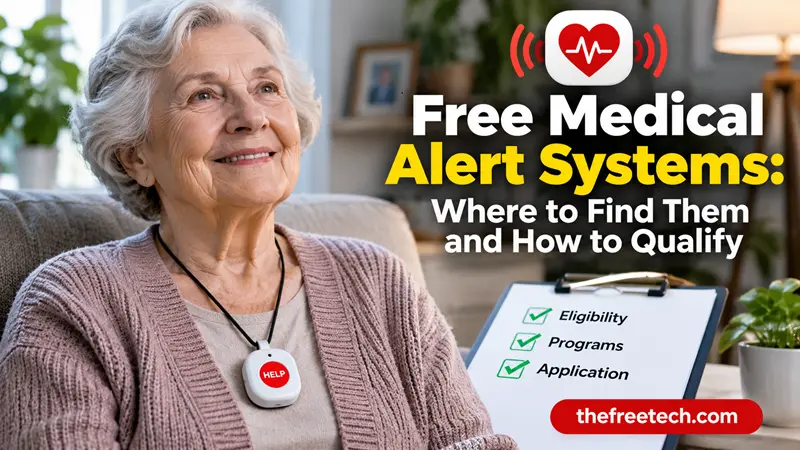
Free Medical Alert Systems: Where to Find Them and How to Qualify

Indeed, you can get your medical alert device free of charge by enrolling in Medicaid, certain Medicare Advantage plans, Veterans Affairs, and community programs. But whether you qualify will depend on your state, income level, health requirements, and insurance plan.
What is crucial to understand here is that a free alarm device doesn't necessarily mean a free service. In some cases, it is covered by your program partially.
If you are an older person living alone and are vulnerable to falls, those are the organizations where you should apply first.
6 Ways to Get a Free Medical Alert System
There is no universal government program that provides free medical alert systems to everyone. However, several assistance programs may cover some or all of the costs.
1. Medicaid Home and Community-Based Services
Medicaid is one of the first places to check if you need a medical alert system but cannot afford monthly monitoring fees.
Depending on your state, Medicaid may cover a Personal Emergency Response System (PERS) through Home and Community-Based Services (HCBS) waivers or other long-term care programs.
These programs help eligible individuals receive support at home instead of moving into institutional care.
What may be covered:
Medical alert equipment, such as a wearable emergency button.
Installation and activation.
Monthly monitoring services.
Certain maintenance expenses.
Who may qualify?
Eligibility varies by state and program. Applicants may need to meet financial requirements, demonstrate a functional or medical need, and qualify for specific home-care services.
How to apply:
Contact your state Medicaid office.
Ask whether your Medicaid plan covers Personal Emergency Response Systems.
Ask about HCBS waivers and other long-term care assistance.
Request an assessment if one is required.
Confirm whether equipment and ongoing monitoring are both covered.
For example, Washington State's Department of Social and Health Services identifies PERS as a service available through many Medicaid programs.
Official resource: https://www.dshs.wa.gov/adult-and-aging-services/information-long-term-care-professionals-and-providers/home-and-community-services/care-options
2. Medicare Advantage Plans
If you have Medicare, check whether your Medicare Advantage plan includes medical alert benefits.
Original Medicare (Parts A and B) generally does not cover medical alert systems. However, Medicare Advantage plans may offer additional benefits beyond standard Medicare coverage.
Depending on the insurer and plan, these additional benefits may include personal emergency response devices or assistance with related services.
What should you check?
Whether your plan covers a medical alert device.
Whether monthly monitoring is included.
Whether you must use an approved provider.
Whether the benefit has an annual allowance.
Whether you must meet specific eligibility requirements.
How to find out:
Call the customer service number on the back of your Medicare Advantage insurance card.
Ask this specific question:
"Does my current plan cover a personal emergency response system, including the device and monthly monitoring?"
Do not assume every Medicare Advantage plan offers this benefit. Coverage differs between insurers and individual plans.
Official resource: https://www.medicare.gov/basics/get-started-with-medicare/get-more-coverage/your-coverage-options
3. Veterans Affairs (VA) Benefits
Eligible veterans may be able to receive a medical alert system through VA health care benefits.
The VA may provide personal emergency response equipment when a veteran has a medical need and meets applicable eligibility requirements.
Factors that may be considered include:
A history of falls or an increased risk of falling.
Living alone or spending extended periods alone.
Physical limitations that make calling for help difficult.
Medical conditions that create an increased risk of emergencies.
How to request assistance:
Contact your VA health care provider.
Explain why you need an emergency alert device.
Discuss your fall risk, mobility limitations, and living situation.
Ask whether a personal emergency response system is available through your VA benefits.
Follow the assessment and approval process.
Some VA-supported programs work with specific medical alert providers. Device availability, monitoring arrangements, and eligibility should be confirmed with your VA care team.
Official resource: https://www.va.gov/health-care/
4. Area Agencies on Aging (AAA)
Area Agencies on Aging help older adults access community-based services, financial assistance, and support programs.
Depending on the community, these agencies may know about grants, local assistance funds, nonprofit partnerships, or programs that help pay for medical alert equipment.
Not every agency provides free devices directly, but contacting one can help you identify assistance that may otherwise be difficult to find.
How to find your local agency:
Use the federal Eldercare Locator:
You can also call 1-800-677-1116.
Ask whether your local Area Agency on Aging knows of programs that provide free or subsidized personal emergency response systems.
When calling, explain your age, living situation, financial circumstances, and need for emergency assistance.
5. Nonprofit and Community Assistance Programs
Some nonprofit organizations, charitable foundations, and community groups offer financial assistance to older adults and people with disabilities.
Depending on available funding, assistance may include:
Donated medical alert equipment.
Emergency preparedness grants.
Financial assistance for monitoring fees.
Referrals to subsidized safety equipment programs.
Potential places to ask include local senior centers, disability support organizations, community foundations, and charitable organizations.
Availability is highly localized, so there is no guarantee that a particular organization will provide a free system.
A useful approach is to contact your local senior services agency and ask for referrals to organizations offering personal safety equipment assistance.
6. Long-Term Care Insurance and Other Health Benefits
If you have long-term care insurance, private health insurance, or another supplemental benefit, review your policy before paying out of pocket.
Some policies may reimburse or cover personal emergency response equipment as part of broader home-care or independent-living benefits.
However, coverage depends on the policy wording.
Check whether your benefits include:
Personal emergency response equipment.
Medical alert monitoring.
Home safety services.
Assistive technology.
Emergency communication devices.
Ask your insurer whether prior authorization or a physician's recommendation is required.
Are Free Medical Alert Systems Really Free
Not always.
Some companies advertise free medical alert devices, but the customer may still have to pay for monthly monitoring or other services.
Before accepting an offer, find out exactly which expenses are included.
| Expense | What to check |
|---|---|
| Equipment | Is the device provided at no cost? |
| Monthly monitoring | Is 24/7 monitoring included? |
| Activation | Is there an initial setup fee? |
| Installation | Is professional installation free? |
| Shipping | Are delivery costs covered? |
| Cancellation | Are there termination fees? |
| Replacement | Is damaged or lost equipment covered? |
Important: A free pendant without an active monitoring service may not provide the same protection as a professionally monitored medical alert system.
Always request the complete cost breakdown in writing before enrolling.
What Features Should a Free Medical Alert System Include?
Getting a system at no cost is helpful, but the device must also meet the user's safety needs.
Here are the features worth checking before accepting any program or device.
24/7 Emergency Monitoring
A professionally monitored system connects the user to a response center when the emergency button is activated.
The operator can follow a predetermined response plan, which may include contacting emergency services or designated caregivers.
Confirm that monitoring is included in the assistance program.
Automatic Fall Detection
Some medical alert devices can detect certain falls and automatically send an alert.
This feature can be useful for someone who may be unable to press an emergency button after falling.
However, automatic fall detection is not perfect. It may miss some falls or generate false alerts.
Ask whether this feature is included or requires an additional monthly fee.
GPS Location Tracking
For people who spend time outside the home, a mobile medical alert device with GPS can help responders identify their location.
Check whether the device works outside the home and whether cellular service is included.
Waterproof Equipment
A waterproof emergency button can be particularly useful in bathrooms, where slips and falls may occur.
Check the manufacturer's water-resistance rating rather than assuming every wearable device is suitable for shower use.
Comfortable and Easy-to-Use Design
The person using the device should be comfortable wearing it regularly.
Common options include:
Neck pendants.
Wristband buttons.
Mobile emergency alert devices.
Smartwatch-style medical alert devices.
Consider hand strength, vision, hearing, memory, and dexterity when selecting equipment.
Free vs. Low-Cost Medical Alert Systems
If you cannot qualify for a completely free system, a lower-cost option may still provide valuable protection.
| Option | Potential benefit | Important limitation |
|---|---|---|
| Medicaid assistance | May cover equipment and monitoring | State and eligibility restrictions |
| Medicare Advantage | May offer additional coverage | Depends on the specific plan |
| VA assistance | May cover eligible veterans | Requires approval and medical need |
| Local aging programs | May provide referrals or financial assistance | Funding varies by community |
| Nonprofit assistance | May offer donated equipment or grants | Availability is limited |
| Private medical alert providers | More equipment and service choices | Usually involves recurring fees |
Compare the total cost over 12 months, not just the advertised equipment price.
How to Apply for a Free Medical Alert System
If you are unsure where to begin, follow this order:
Step 1: Check your insurance.
Find out whether Medicaid, Medicare Advantage, or another insurance policy offers coverage.
Step 2: Contact your local aging services agency.
Use the Eldercare Locator at https://eldercare.acl.gov/ to find community assistance.
Step 3: Ask your healthcare provider.
Explain your safety concerns and ask whether a medical alert system is appropriate.
Step 4: Explore veterans' benefits if applicable.
Contact the VA to discuss available equipment and eligibility.
Step 5: Compare the actual costs.
Confirm whether the equipment, installation, monitoring, and replacement services are included.
Step 6: Test the system before relying on it.
Learn how to activate the device, test its connection, and update emergency contacts.
FAQ
Can I get a free medical alert system through Medicare?
Original Medicare generally does not cover medical alert systems. However, some Medicare Advantage plans may offer personal emergency response benefits. Contact your plan to confirm its coverage.
Does Medicaid pay for Life Alert?
Some Medicaid programs may cover personal emergency response systems, including equipment and monitoring. Coverage depends on your state, waiver program, and individual eligibility.
Can seniors get free medical alert systems?
Yes, some seniors qualify through Medicaid, VA benefits, Medicare Advantage plans, or local assistance programs. There is no universal free program available to every senior.
Are there free medical alert systems for disabled adults?
Some disabled adults may qualify for assistance through Medicaid HCBS waivers, disability support programs, and local community organizations. Eligibility and covered services vary.
Can veterans get free medical alert devices?
Eligible veterans may receive assistance through VA health care programs. Contact a VA healthcare provider to discuss medical necessity, available devices, and approval requirements.
Is a free medical alert device the same as a monitored system?
No. A device may be free while the monitoring service requires a monthly subscription. Always confirm whether emergency monitoring is included.
What if I cannot qualify for a free medical alert system?
Consider local nonprofit assistance, insurance benefits, discounted monitoring plans, and other lower-cost safety options. Your Area Agency on Aging may help identify programs in your community.