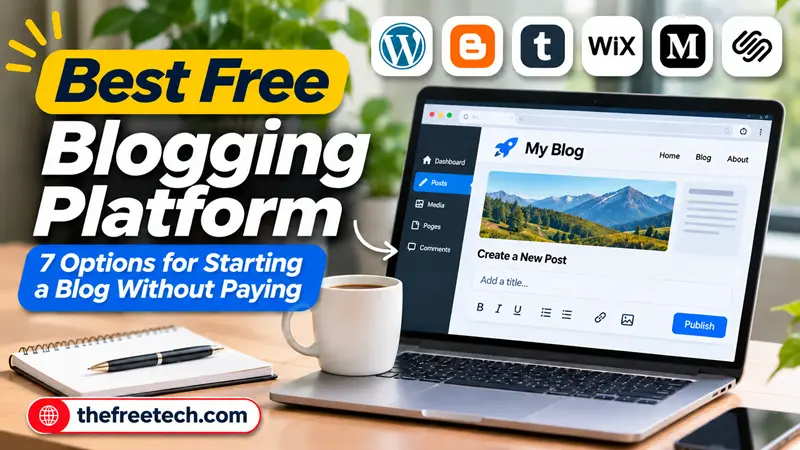
Best Free Blogging Platform: 7 Options for Starting a Blog Without Paying

If you plan to establish your blog without paying any money, WordPress.com would be the ideal platform for free users. The platform is very easy to use, provides several themes and tools, and you can always upgrade your blog once it starts growing.
However, it may not be the best choice for everyone. You may go with Blogger if you are interested in Google-supported platform, but you should go with Medium if your priority is writing.
Here are the main choices:
| Platform | Best for | Free option | Main limitation |
|---|---|---|---|
| WordPress.com | Most new bloggers | Yes | Advanced customization requires upgrades |
| Blogger | Simple personal blogs | Yes | Less modern design and ecosystem |
| Medium | Writers seeking built-in readership | Yes | Limited control over site branding |
| Substack | Newsletters + blogging | Yes | Designed around email subscriptions |
| Wix | Visual website builders | Yes | Free site uses a Wix-branded address |
| Tumblr | Short-form and community content | Yes | Less suited to traditional long-form business blogs |
| Ghost | Professional publishing | Free software, but hosting is not generally free | More technical to self-host |
1. WordPress.com — best overall for most beginners
Choose it if: You want a conventional blog that you can start free and expand later.
Start a free WordPress.com blog
WordPress.com is the strongest all-purpose choice because it gives beginners a relatively simple way to publish posts while leaving room for a more sophisticated website later. Its official site currently describes a free starting option alongside paid plans and managed hosting.
It is particularly suitable for:
Personal blogs
Hobby blogs
Educational content
Portfolio-style sites
Small content projects
Bloggers who may eventually want a custom domain or additional features
The important distinction is that WordPress.com and self-hosted WordPress are not the same thing. A free WordPress.com site is hosted for you. Self-hosted WordPress requires separate hosting and gives you substantially more control.
Best choice when: You want your blog to become a long-term website rather than simply a place to publish occasional posts.
2. Blogger — best simple free blogging platform
Choose it if: You want a straightforward blog without dealing with hosting.
Blogger has been around for decades and remains attractive because its basic publishing model is simple. It is especially reasonable for personal blogs, journals, basic informational sites, and anyone who wants a no-cost starting point.
Its biggest advantage is also its biggest limitation: simplicity.
You don't get the same breadth of modern publishing and customization options associated with larger blogging ecosystems. For someone who simply wants to write and publish, however, that may not matter.
Best choice when: You value simplicity more than advanced design or extensibility.
3. Medium — best for writers who care about publishing, not website management
Choose it if: Your main goal is publishing articles and potentially reaching readers already using the platform.
Medium describes itself as a publishing platform where people read and share stories and ideas. It also offers free accounts for readers and writers.
Medium removes much of the website-building work. You create an account, write, format, and publish.
That makes it fundamentally different from platforms where you're expected to build and maintain your own branded site.
Medium is a good fit for:
Essays
Commentary
Personal stories
Professional writing
Thought leadership
Readers who prefer a distraction-free writing environment
The trade-off is control. Your blog lives within Medium's ecosystem rather than functioning like a fully independent website.
Best choice when: Writing is the product and website ownership is secondary.
4. Substack — best for blogs built around email
Choose it if: You want every article to potentially become a newsletter.
Start a free Substack publication
Substack is particularly useful when your blogging strategy revolves around developing a direct relationship with readers through email. Substack currently promotes starting a newsletter, podcast, or video show for free.
Instead of thinking of your blog as simply a website, think of it as a publication with a subscriber list.
That makes it especially useful for:
Newsletters
Independent publishing
Expert commentary
Niche publications
Serialized writing
Creators who want to build an audience they can contact directly
If your only objective is a traditional SEO-focused blog, another platform may be a better fit. If email subscribers are central to your strategy, Substack becomes much more compelling.
Best choice when: Your blog and newsletter are essentially the same product.
5. Wix — best for beginners who want more visual control
Choose it if: You want your blog to sit inside a visually designed website.
Explore Wix's official website and blog tools
Wix approaches blogging from a broader website-building perspective. Its official resources include dedicated guidance for creating websites and blogs.
That makes it useful if your blog is only one part of what you want to create.
For example, you might want:
A homepage
About page
Services
Portfolio
Contact page
Blog
The free option lets you start without paying for hosting, but free websites come with platform limitations and branding.
Best choice when: The website design matters as much as the blog itself.
6. Tumblr — best for short-form and community-driven publishing
Choose it if: You want a casual publishing platform with a strong community component.
Tumblr sits somewhere between blogging and social publishing. It works particularly well for short posts, images, commentary, fandoms, creative communities, and highly shareable content.
It is less compelling if you're building a conventional business blog where you need a polished information architecture and extensive control over the site.
Best choice when: Community interaction and informal publishing matter more than traditional website structure.
7. Ghost — best for publishers who want control, with an important catch
Choose it if: You want a professional publishing platform and are comfortable handling hosting.
Ghost is designed around publishing, newsletters, memberships, and content ownership. Its open-source software can be used without paying a software licensing fee.
But calling Ghost a completely free blogging solution can be misleading.
The software can be free; hosting generally isn't.
If you self-host Ghost, you still need somewhere to run it. That makes it different from WordPress.com, Blogger, Medium, and other hosted platforms that provide a free entry point.
Best choice when: You want greater technical control and are willing to manage hosting.
Which Free Blogging Platform Should You Choose
Use your actual goal rather than choosing based on the number of features.
Choose WordPress.com if you want:
A traditional blog that can grow into a larger website.
Choose Blogger if you want:
A basic, no-cost blog with minimal complexity.
Choose Medium if you want:
To focus almost entirely on writing and publishing.
Choose Substack if you want:
Your blog and email newsletter to work together.
Choose Wix if you want:
A visually designed website with blogging included.
Choose Tumblr if you want:
Short-form, creative, and community-oriented publishing.
Choose Ghost if you want:
A more controlled publishing system and don't mind managing hosting.
What Does "free" Actually Mean
This is where many comparisons of free blogging platforms become misleading.
A platform can be free to start while still charging for important capabilities later.
Before choosing one, check these five things:
Custom domain — Can you use
yourname.com, or must you use a platform subdomain?Advertising — Does the free plan display platform advertising?
Storage and bandwidth — Are there meaningful limits on media or traffic?
Design and plugins — Can you customize the site beyond basic templates?
Exportability — Can you move your content elsewhere if you outgrow the platform?
The last point is easy to overlook. If you expect your blog to become a serious business, portability matters.
The Best Free Blogging Platform for SEO
If organic search is your primary goal, don't choose a platform solely because it claims to be "SEO friendly."
Search performance depends on much more than the blogging platform. Your content quality, search intent, internal linking, site structure, technical performance, authority, and ability to publish useful material all matter.
For a long-term content strategy, I'd generally favor a platform that gives you room to control:
Page titles and descriptions
URL structure
Internal links
Site architecture
Categories and tags
Images and media
Structured content
Domain ownership or portability
That usually makes WordPress.com a stronger starting point than a platform designed primarily as a social publishing feed, particularly if you expect the site to become an independent content property.
Should You Start with a Free Blog or Buy Hosting
Start free if you're testing an idea.
A free platform makes sense when you are:
Learning how blogging works
Testing whether you enjoy publishing
Starting a personal project
Building an audience before investing money
Unsure whether the topic has long-term potential
Consider paid hosting or a paid plan when you need:
A custom domain
More control over design
Advanced functionality
Better monetization options
Greater ownership and portability
A professional business presence
You don't need to spend money simply because you're starting a blog.
The best free blogging platform is the one that removes the obstacle preventing you from publishing.